


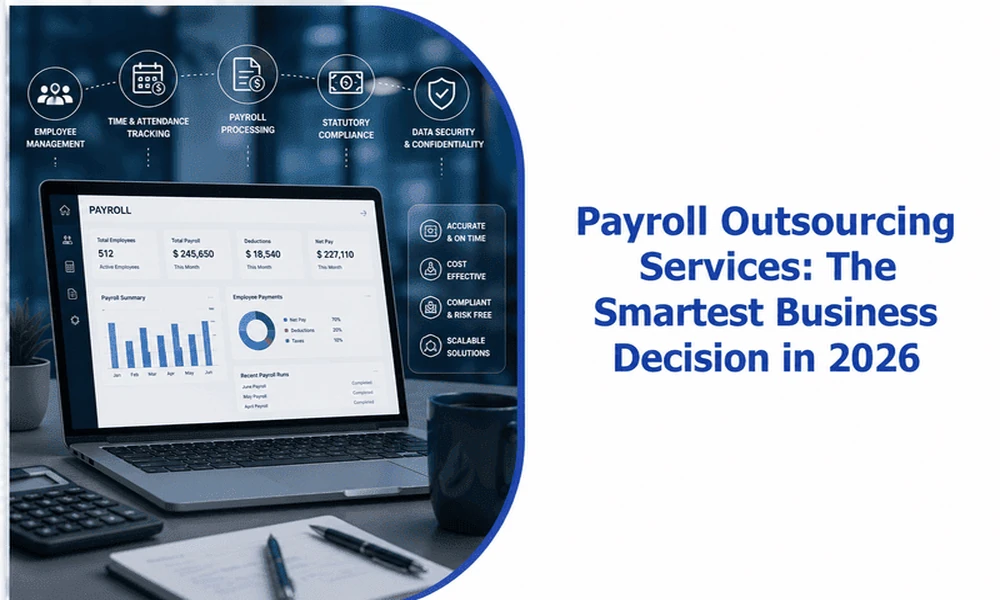
In today’s competitive business environment, companies want to spend less time on repetitive back-office tasks like salary calculation, tax deduction, and compliance filing, and more time on their core operations. This is exactly why the demand for Payroll Outsourcing Services is growing rapidly across India. Whether you are a startup or a large enterprise, payroll is one function where even a small error can damage employee trust and expose the business to legal risk.
In this blog, we take a deep look at what payroll outsourcing really means, how a modern payroll management system works, what leading payroll service providers offer, and how to choose the right payroll outsourcing companies for your business.
What Are Payroll Outsourcing Services?
Payroll outsourcing means handing over your company’s entire salary and compliance process to an expert third-party partner, while your team retains final approval. It typically covers:
- Salary calculation and gross-to-net processing
- Tax deduction (TDS) and statutory filings
- Provident Fund (PF), ESI, and Professional Tax (PT) management
- Payslip generation and employee self-service
- Compliance reporting and audit-readiness
With India’s four new Labour Codes now in effect, wage definitions, benefits, and working-hour rules are changing. Because of this, payroll is no longer just a back-office task – it has become a strategic function that only expert payroll outsourcing companies can manage reliably.
Why Payroll Outsourcing in India Matters for Every Business
When a company has five employees in one office, managing payroll is simple. But as a business expands across states, PF, ESI, and PT rules – which differ from state to state – turn into a complex compliance maze. A single small mistake can lead to penalties, compound interest, or even a legal notice.
This is why payroll outsourcing in India is no longer limited to large enterprises – startups and mid-size businesses are adopting it just as quickly. Here are the key reasons:
1. Cost Savings
Maintaining an in-house payroll team involves salary costs, software licensing, and ongoing training. Outsourcing typically helps businesses save 30-40% on payroll costs, since a professional provider brings automation and economies of scale.
2. Accuracy and Compliance
Professional payroll processing services use AI-based validation tools that check every input before calculation. This drastically reduces manual errors and ensures statutory deadlines are never missed.
3. Time Efficiency
HR and finance teams can redirect valuable time away from salary processing and filings toward strategic work such as employee engagement, hiring, and business growth planning.
4. Data Security
Payroll data is among the most sensitive data a company holds – salaries, bank details, and identity information. Trusted providers keep this data encrypted and audited, holding certifications such as ISO 27001, ISO 27701, SOC 1 Type 2, and SOC 2 Type 2, and remain compliant with India’s DPDP Act.
5. Scalability
As a business expands into new states or countries, a good payroll management system scales without needing to be rebuilt – a single engine can handle multiple workforce types, including white-collar, blue-collar, gig, and global employees.
How a Modern Payroll Management System Works
A well-designed payroll workflow generally runs through four steps:
- Employee Data Collection – Joiners, exits, attendance, and pay changes are pulled from the HRMS and validated.
- Payroll Processing – Earnings, deductions, taxes, and benefits are computed gross-to-net, with anomalies flagged for review.
- Disbursement – Salaries are released on schedule across bank rails, with maker-checker controls in place.
- Reporting & Compliance – TDS, PF, ESI, PT, and GST are filed on time, along with payslips and year-end tax-proof validation.
Today’s leading payroll service providers offer AI-assisted validation, real-time analytics, and employee self-service portals – features that catch errors before a payslip is generated, not after.
What to Look For When Choosing Payroll Outsourcing Companies
Not every provider is the same. Some offer little more than software access dressed up as “outsourcing,” while the actual compliance responsibility still sits with you. When evaluating a partner, check for:
- End-to-end compliance coverage: PF (EPFO filings), ESI, TDS (24Q filings, Form 16), Professional Tax (state-wise), Statutory Bonus, Gratuity, and LWF.
- Technology and automation: AI-based validation, HRMS/ERP integration, and real-time dashboards.
- Data security certifications: ISO 27001, SOC 2 Type 2, and DPDP-alignment.
- Dedicated account management: a single point of contact who understands your payroll.
- Flexible, modular pricing: pay-as-you-need rather than a rigid package.
- Proven track record: client retention, case studies, and deep domain experience.
Payroll Processing Services Tailored to Your Workforce
Every company’s workforce is different, so a good provider offers multiple models:
- White-collar payroll – Complex CTC structures, benefits, self-service, and tax-proof validation.
- Blue-collar payroll – High-volume, shift-based wages with attendance tracking and geo-fencing.
- Gig and contingent workforce – Worker classification, automated onboarding, and flexible payouts.
- Global payroll – Multi-country runs consolidated into a single dashboard, with local compliance built in.
This flexibility ensures that whether your company is a single-city startup or a global enterprise operating in 50+ countries, payroll runs on one reliable engine.
The Business Impact of Payroll Outsourcing
- For CHROs: Employees receive accurate, on-time pay, transparency improves, and misclassification risk is reduced.
- For CFOs: Costs become predictable, penalties drop, and records stay audit-ready.
- For senior leadership: Expansion into new states or countries becomes easier, without rebuilding payroll infrastructure.
Conclusion
Payroll is a function where a single mistake directly affects employee trust and legal compliance. This is why professional Payroll Outsourcing Services are no longer a luxury – they are a necessity, especially as India’s new Labour Codes and evolving tax regulations continue to raise compliance risk.
By choosing a trusted, technology-driven payroll outsourcing partner, businesses not only save costs but also free up their HR and finance teams for more strategic work. If you’re evaluating a payroll partner for your business, prioritize end-to-end compliance coverage, AI-driven accuracy, and transparent reporting.
Frequently Asked Questions (FAQs)
1. What is payroll outsourcing?
Payroll outsourcing means handing over your company’s salary calculation, tax deduction, and statutory compliance work to an expert third-party provider, while final approval still remains with you.
2. What are the benefits of payroll outsourcing services?
It delivers cost savings (typically 30-40%), better accuracy, time efficiency, and stronger compliance, freeing up HR and finance teams to focus on strategic work.
3. What size of company benefits from payroll outsourcing in India?
From startups to large multinational enterprises, companies of every size can benefit from payroll outsourcing, since it is modular and scalable.
4. Do payroll outsourcing companies keep our sensitive employee data safe?
Yes, trusted providers hold certifications such as ISO 27001, ISO 27701, SOC 1 Type 2, and SOC 2 Type 2, and protect data with 256-bit encryption, role-based access, and multi-factor authentication.
5. What core features should a payroll management system have?
A good system offers automated calculations, statutory compliance filing, an employee self-service portal, real-time analytics, and HRMS/ERP integration.
6. How long does it take to outsource payroll processing services?
Typically 2-3 weeks, covering a diagnostic call, system integration, and a parallel run – all without disrupting your current payroll process.
7. Does payroll outsourcing eliminate compliance risk entirely?
Risk is significantly reduced since expert providers continuously track regulatory changes, but final approval and data access control remain in your hands.
8. What is the difference between blue-collar and white-collar payroll processing?
Blue-collar payroll focuses more on attendance, shift-based wages, and geo-fencing, while white-collar payroll focuses on complex CTC structures, benefits, and tax-proof validation.
9. Can payroll outsourcing companies handle multi-country payroll?
Yes, many leading providers manage payroll across 50+ countries through a single centralized dashboard, with local compliance built in for each market.
10. How do I choose the right payroll outsourcing company?
Look for end-to-end compliance coverage, technology-driven automation, data security certifications, dedicated account management, and flexible pricing before selecting a provider.
