


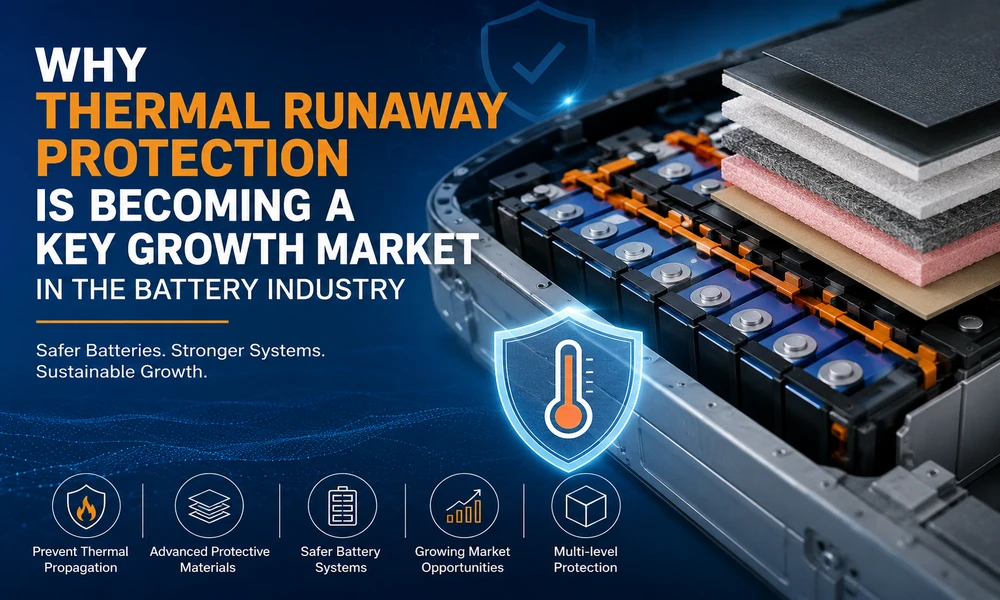
As lithium-ion batteries become central to electric vehicles, energy storage systems, data centers, industrial equipment, and other electrified applications, battery safety is moving from a technical consideration to a major commercial priority. Among the different safety challenges facing the industry, thermal runaway has become one of the most critical.
Thermal runaway can begin with an internal short circuit, overcharging, mechanical damage, manufacturing defects, or excessive temperature. Once initiated, a cell can generate heat faster than it can dissipate it, potentially leading to fire and propagation to neighboring cells.
For battery manufacturers and system integrators, the question is therefore changing from simply “How do we prevent thermal runaway?” to “How do we prevent one cell failure from becoming a system-level event?”
This shift is creating a rapidly expanding market for thermal insulation, flame-retardant, electrical insulation, cushioning, and thermal propagation protection materials.
1. Battery Growth Is Expanding the Thermal Runaway Protection Market
The first driver is straightforward: more batteries are being deployed across more applications.
Electric vehicles continue to require larger and increasingly energy-dense battery packs, while battery energy storage systems (BESS) are moving toward larger installations and longer-duration applications. Batteries are also appearing in commercial vehicles, marine systems, industrial machinery, robotics, and backup power infrastructure.
This expansion creates a multiplier effect for battery safety materials.
A battery system does not only require active safety technologies such as battery management systems, sensors, cooling systems, and fire detection. It also requires passive protection materials positioned between cells, modules, and structural components.
As battery deployment increases, the addressable market for these materials grows alongside it.
More importantly, the value of safety materials per battery system can also increase as manufacturers introduce additional layers of protection.
2. Higher Energy Density Makes Propagation Control More Important
Battery manufacturers are constantly trying to improve energy density. More energy stored within the same space can improve EV driving range and reduce the footprint of stationary energy storage systems.
However, higher energy density can also increase the consequences of a thermal event.
This creates an engineering challenge: safety materials must provide effective protection while occupying minimal space and adding as little weight as possible.
As a result, the market is shifting away from evaluating materials based only on basic properties such as thickness or unit price. Battery designers increasingly need to consider a combination of characteristics including:
- Thermal insulation performance
- Flame resistance
- Electrical insulation
- Compression and cushioning behavior
- High-temperature stability
- Smoke and combustion characteristics
- Thickness and weight
- Long-term durability
This creates opportunities for advanced material suppliers capable of delivering multi-functional solutions rather than single-purpose materials.
3. Thermal Runaway Protection Is Becoming a Multi-Level System
One of the most important developments in the battery safety market is that thermal runaway protection is no longer limited to one barrier or component.
Instead, protection is increasingly designed across multiple levels.
Cell-Level Protection
At the cell level, materials can provide electrical insulation, flame resistance, spacing, and localized protection. For example, PC insulation flame-retardant sheets can help provide electrical isolation while supporting the safety architecture around individual cells.
Module-Level Protection
The module level becomes particularly important for controlling thermal propagation.
Materials such as ceramifiable silicone foam can perform different functions, from cushioning and sealing to thermal insulation and high-temperature protection.
When a cell enters thermal runaway, carefully selected materials can help reduce heat transfer to adjacent cells or surrounding components, buying valuable time for the system’s other safety mechanisms to respond.
Pack-Level Protection
At the pack level, materials need to address a broader combination of thermal insulation, structural integration, cushioning, and protection of surrounding components.
Solutions such as PIR thermal insulation cushioning boards can become part of this final protection layer.
This cell-module-pack architecture significantly expands the commercial opportunity because one battery system can require multiple material technologies rather than a single thermal barrier.
4. BESS Is Creating a Particularly Important Growth Opportunity
Stationary energy storage represents another major opportunity for thermal runaway protection materials.
An EV battery pack is large, but a utility-scale BESS installation can contain an enormous number of cells concentrated within modules, racks, cabinets, and containers.
In this environment, propagation control becomes especially important.
A thermal event that remains localized has fundamentally different consequences from one that spreads across cells, modules, or racks. Therefore, BESS safety design increasingly emphasizes multiple layers of prevention, detection, isolation, thermal management, and fire protection.
For material suppliers, this means the addressable opportunity extends beyond EV battery packs into energy storage cabinets, containerized BESS solutions, commercial energy storage, and utility-scale projects.
5. Safety Materials Are Moving from “Components” to “Engineered Solutions”
This market evolution is also changing the relationship between battery manufacturers and material suppliers.
Historically, a supplier might simply provide foam, insulation sheets, or flame-retardant materials according to a customer’s specifications.
That model is becoming less sufficient.
Battery architectures vary considerably in cell format, chemistry, spacing, module design, cooling strategy, operating temperature, and mechanical requirements. A material performing well in one configuration may not automatically be suitable for another.
Customers therefore increasingly value suppliers that can support:
Material selection → prototype development → testing → customization → system integration → mass production.
This creates an important competitive shift. The future market may not simply favor companies capable of manufacturing insulation materials at the lowest cost. It may favor suppliers that understand how different materials work together within the complete battery safety architecture.
6. Thermal Runaway Protection Is Becoming a Strategic Materials Market
The commercial significance of thermal runaway protection goes beyond rising battery production volumes.
Three trends are occurring simultaneously: battery deployment is increasing, energy density continues to rise, and safety requirements are becoming more demanding.
Together, these forces are increasing the importance of passive safety materials.
This means thermal insulation boards, flame-retardant sheets, specialty foams, cushioning materials, electrical insulation components, and high-temperature barriers are gradually moving from supporting components toward strategic battery safety materials.
For material manufacturers, the opportunity is therefore not simply to sell more individual products.
The larger opportunity is to build a complete portfolio covering cell-level, module-level, and pack-level thermal runaway protection, and to work with battery manufacturers and energy storage integrators from the early stages of system design.
Conclusion
Thermal runaway protection is becoming a key growth market because battery safety is increasingly being engineered as a system rather than addressed through a single component.
As EV and BESS markets expand, battery manufacturers need solutions capable of preventing electrical failures, slowing heat transfer, resisting flames, cushioning cells, and limiting thermal propagation across multiple levels of the battery system.
