


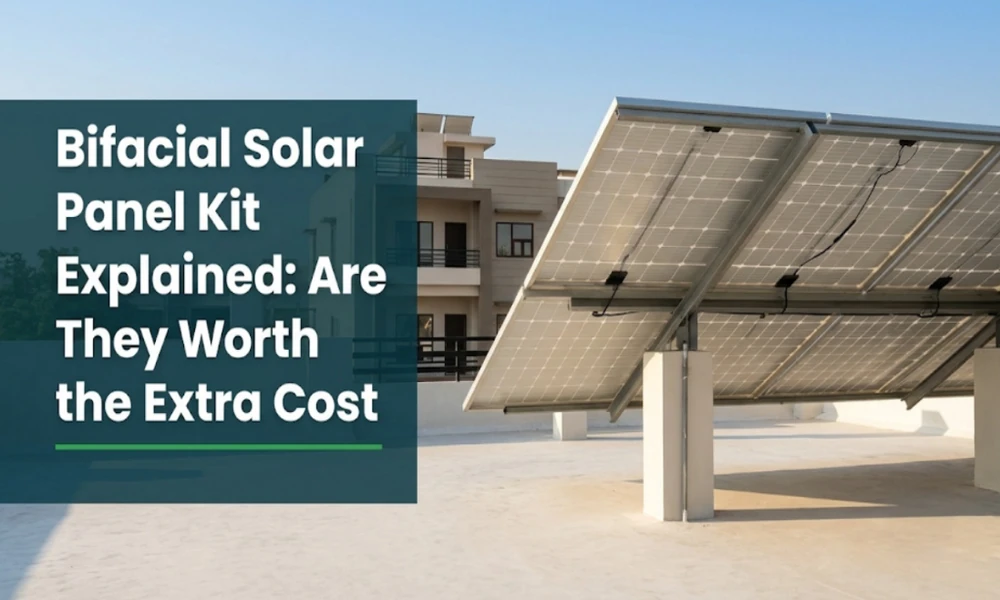
If you have been browsing solar roofs recently, you’ve likely come across the term “bifacial” almost everywhere. This seems like a more advanced option, and the price matches that impression. So does a bifacial solar kit really offer its advantages justifying the additional cost, or is it only suitable for promotional brochures but not for your rooftop?
What is a bifacial solar panel kit?
A standard solar panel collects the sun rays that fall on the frontal part. A double-sided panel, on the other hand, has an open back. This allows the panel to collect the sun rays reflected by the ground and the surroundings. Solar panel kits come with solar panels and all the additional equipment. For the homeowner, this means reduced decision-making and five warranty talks into one.
How much extra power can you really expect?
This is the point at which a lot of the misunderstanding arises. The rear side gain will vary depending on the material present beneath your panels. When installed over a dark roof, the gain will range up to 5 percent. In cases where the panels are installed over a light colored terrace, and the panel is tilted upwards and away from the roof, the rear side gain can increase to about 10 percent or slightly more. Claims of up to 20 or 30 percent normally arise from perfect ground mount systems.
What does the extra cost look like?
A bifacial module typically costs a bit more per watt than a mono PERC module, around 5 to 10 percent more. In total, when compared to the entire system including the inverter, structure, cabling, and installation costs, the bifacial modules end up being cheaper. For a 3 kW system, it can vary depending on brands and markets, but the cost difference would be somewhere between Rs 5,000 and Rs 9,000.
Here is an illustration for you. Suppose your solar panels help save you Rs 3,000 every month on your utility bill. A 7 percent boost in the output from the back side means additional savings of around Rs 210 per month or Rs 2,500 annually. The cost difference is about Rs 7,000, and the ROI will take less than 3 years with panels lasting at least 25 years. In case of a mere 3 to 4 percent improvement in efficiency, the time will be six years.
Benefits beyond the extra units
Most bifacial panels use a glass-on-glass build instead of a plastic back sheet. That makes them tougher against moisture, heat, and dust, and they tend to degrade a little slower over the years. Many also come with longer performance warranties. If you live in a humid or coastal area, this durability alone can justify the choice.
When a bifacial kit makes sense
If you have a flat, light-colored roof or terrace where you could angle the panels and keep some space below them, there is enough sunlight without any shadow and you would be living in the same place for a longer period of time, then you should go for bifacial panels.
However, you should choose the conventional ones when you have a sloped roof where the panels will remain flat on the roof, your roof is dark in color, or you have a limited budget.
Choosing the right manufacturer
A great panel from a weak company is still a risk, because you are depending on it for 25 years. When comparing residential solar panel manufacturers, check how long they have been in business, whether they manufacture in India, what the product and performance warranties say, and how easy it is to reach their service team. Waaree is one of India’s largest solar panel manufacturers, and buying a kit from an established name makes claims and support far easier to handle later.
The bottom line
A bifacial solar panel kit can be worth the extra cost when your roof provides enough reflected light for the rear side to generate additional power. On a dark, sloped roof, the extra output may be limited, so consider your roof conditions, budget, and long-term energy needs before deciding. When comparing residential solar panel manufacturers, Waaree Energies stands out as an established Indian solar company with over 25.8 GW of manufacturing capacity. Choosing suitable panels for your roof and energy needs can help you get more value from your solar investment.
