


On construction sites, sound barriers are often treated like a standard item on a checklist. Put them up along the boundary, tick the compliance box, and move on. The reality is far less straightforward. Construction noise changes constantly, and so the way barriers are used needs to change with it.
That is why it helps to stop thinking in terms of “what types exist” and start thinking in terms of “when each type actually makes sense”. Because on a live site, timing, positioning, and purpose matter just as much as the sound barrier itself.
When early-stage works create unpredictable noise.
At the start of a project, noise tends to be messy. Excavation, demolition, and groundwork do not stay in one place for long. Equipment moves, tasks shift, and the loudest activity today may not be the loudest tomorrow.
This is where temporary and modular barriers are used most heavily. They are quick to install, easy to reposition, and flexible enough to follow the work as it moves across the site.
You are not aiming for perfect noise reduction at this stage. You are aiming for responsiveness. Being able to adjust the barrier quickly often matters more than having the highest-performing system in place.
When fixed plant equipment becomes the main source.
As the project progresses, certain noise sources become more stable. Generators, compressors, batching plants, and other fixed equipment start to dominate.
This is when more targeted barrier use comes into play. Instead of relying only on perimeter barriers, localised solutions are introduced around the equipment itself.
Partial enclosures or dedicated acoustic screens are often used here. The idea is to deal with the noise closer to its source rather than trying to block it after it has already spread.
It is a more efficient approach, especially when the equipment runs continuously and contributes a large share of the overall noise.
When the site is surrounded by sensitive areas.
Not all boundaries are equal. One side of a site might face an open road, while another might be directly next to residential flats, offices, or even hospitals.
In these sensitive zones, higher-performance barriers are usually introduced. These tend to be taller, denser, and sometimes include absorptive surfaces to reduce reflection.
The key point here is that barrier use becomes selective. Instead of treating the entire site the same way, more effort is concentrated where it matters most.
That targeted approach often delivers better results than spreading resources evenly across all sides.
When reflection inside the site becomes a problem.
As structures start to go up, the site environment changes. Walls, floors, and surrounding buildings create surfaces that reflect sound.
At this stage, noise can start to feel louder even if the source has not changed. That is because sound is bouncing around rather than escaping cleanly.
This is when sound absorptive barriers or linings become more relevant. They are used to reduce echo and internal noise build-up, not just to block sound at the boundary.
It is a shift in focus. Instead of only protecting people outside the site, you are also improving conditions within it.
When height and space become limiting factors.
In dense urban projects, there is often limited room to install large barrier systems. You might not be able to build as high as you would like, or place barriers at the ideal distance from the noise source.
In these situations, barrier use becomes more strategic. Rather than relying on a single continuous wall, smaller sections may be placed closer to specific noise sources.
You might also see staggered or layered arrangements, where multiple smaller barriers work together instead of one large structure.
It is not the textbook setup, but it is often the only practical option when space is tight.
When visibility and access cannot be compromised.
Construction sites are busy environments. Vehicles, workers, and equipment all need clear lines of sight to operate safely.
That means there are areas where solid barriers are not suitable. Access points, loading zones, and areas near traffic routes often require visibility.
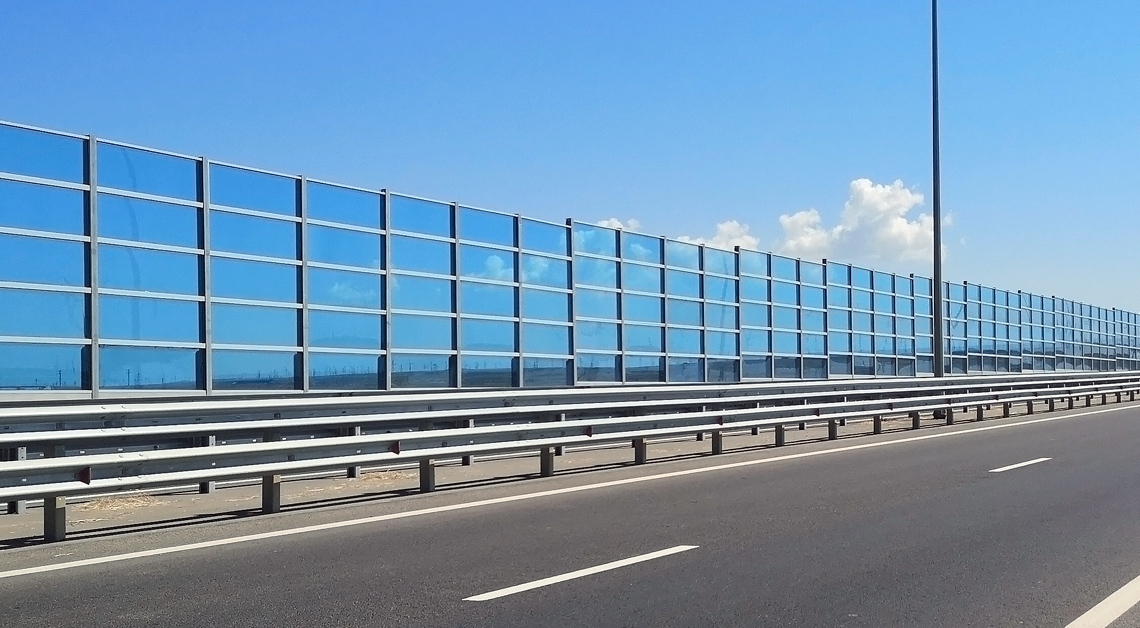
In these cases, transparent panels or lower-height barriers are used. They provide some level of noise reduction while still allowing safe movement and monitoring.
It is a compromise, but a necessary one. Safety and functionality always come first, even if it means accepting slightly lower acoustic performance.
When the project enters later, more stable phases.
As construction progresses into structural and finishing stages, the site becomes more predictable. Noise sources are more defined, and the layout changes less frequently.
This is when more stable barrier setups can be introduced. Instead of constantly moving panels around, the focus shifts to maintaining consistent protection along key boundaries.
At this stage, barriers may be reinforced, extended, or upgraded depending on remaining works. The goal is to maintain compliance and minimise disruption as the project approaches completion.
When one type is not enough.
Most construction sites do not rely on a single type of barrier throughout the entire project. Different phases require different approaches, and often multiple types are used at the same time.
Temporary panels might handle moving works, while fixed enclosures deal with constant machinery. Absorptive linings might reduce internal noise, while perimeter barriers protect nearby buildings.
This layered approach is not overkill. It is simply recognising that construction noise is not a single problem with a single solution.
Bringing It All Together
On construction sites, sound barriers are not static installations. They evolve alongside the project.
Early stages demand flexibility. Mid-stages require targeted control around key equipment. Later stages benefit from stability and consistency. Throughout all phases, constraints like space, safety, and surrounding environments shape how barriers are used.
So the real question is not “what types of sound barriers are available?” It is “what does the site need right now?”
Once you approach it that way, barrier selection becomes far more practical. You stop treating it as a one-off decision and start using it as an ongoing tool that adapts to the way construction actually unfolds.
